Best Adjustable Dumbbells: 5 Picks Ranked
5 adjustable dumbbell sets ranked by demand, trust, value, quality & durability. Algorithm-scored picks from Bowflex, PowerBlock, NÜOBELL & more.
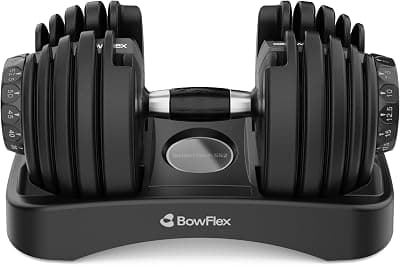
Bowflex SelectTech 552

All 5, ranked
Ranked by our composite score across five dimensions; picks without a composite follow, by a partial score over the measured quality scores only
15Best OverallBowflex$164.50
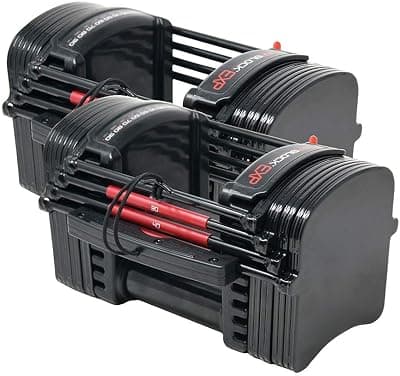
25PowerBlockPowerBlock Elite EXP
Achieved strongest value score by combining expandable capacity up to 90 pounds with price point significantly below comparable systems when factoring expansion economics.
$498.92
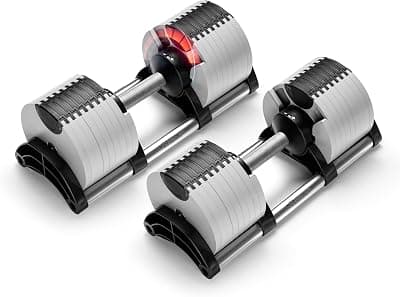
35NÜOBELLNÜOBELL Adjustable Dumbbells 5-80 lb
Budget classification reflects exceptional per-pound value calculation when analyzing 5-80 pound range and premium adjustment speed against long-term utility metrics.
$745.00
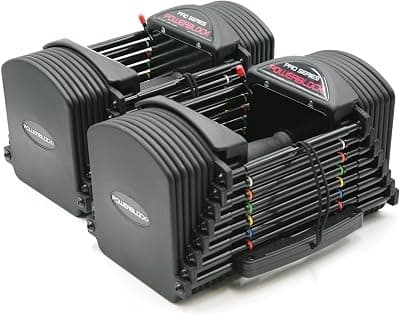
45PowerBlockPowerBlock Pro 50
Mid-range score reflects commercial-grade build quality and extended warranty coverage justified by lower cost-per-workout over multi-year intensive use timelines.
$549.00
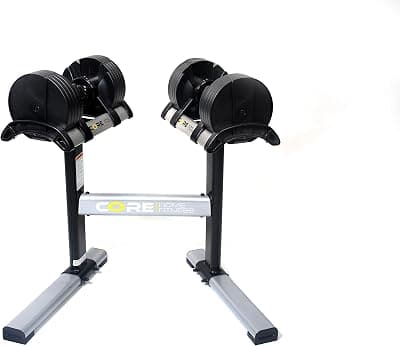
55Core Home FitnessCore Home Fitness Adjustable Dumbbell Set
Honorable mention reflects strong performance in value-for-beginners segment while acknowledging quality trade-offs compared to pro-tier systems.
Currently unavailable
People also ask
How do selector pin systems compare to dial mechanisms for adjustment speed?
Dial mechanisms like the Bowflex SelectTech complete adjustments in 3-5 seconds by rotating a handle to engage internal plates, while selector pin systems like PowerBlock require 5-8 seconds to remove and reinsert pins through numbered holes. Twist-handle designs like NÜOBELL achieve 2-second changes by eliminating pins entirely, using internal locking plates that engage with a quarter-turn rotation. The speed difference compounds during high-rep circuits or supersets where frequent weight changes occur, potentially saving 2-3 minutes per workout with faster systems.Is the weight range more important than adjustment speed?
Weight range matters more for long-term progression and exercise variety, while adjustment speed impacts workout efficiency and training style. Buyers planning multi-year use should prioritize expandable systems reaching 70-90 pounds to avoid repurchasing as strength increases, even if adjustment takes a few extra seconds. Athletes doing high-intensity interval training or drop sets benefit more from sub-5-second mechanisms that maintain workout momentum. Most intermediate lifters find 50-60 pound capacity adequate for 12-24 months before needing heavier loads on major compound movements.Can adjustable dumbbells handle explosive movements like cleans and snatches?
Steel-frame systems like PowerBlock Pro withstand explosive lifts better than plastic-housed models due to superior drop-impact resistance and plate stability during rapid acceleration. Commercial-grade models with urethane coating and tighter tolerances reduce internal plate shift that can destabilize the load mid-movement. Entry-level systems with plastic components should be limited to controlled tempo exercises to prevent mechanism damage from aggressive dropping or ballistic movements. Serious Olympic lifting still favors fixed dumbbells or specialty training tools over any adjustable system.Do compact designs sacrifice durability compared to larger adjustable systems?
Compact designs prioritize space efficiency through tighter component integration, which can reduce serviceability but does not inherently compromise durability if construction quality remains high. Systems like NÜOBELL achieve small footprints using precision-machined steel parts that match or exceed larger frame durability under normal training conditions. The trade-off appears in drop-impact tolerance where open-frame designs like PowerBlock absorb force across distributed contact points better than enclosed compact mechanisms. Proper handling extends lifespan across all design types regardless of size.What maintenance do adjustable dumbbells require over time?
Selector pin systems need periodic pin inspection for bending or wear that prevents secure engagement, with replacement pins readily available from manufacturers. Dial mechanisms benefit from occasional cleaning of adjustment tracks to remove chalk dust or debris that can impede smooth rotation. Steel components should be wiped down after sweaty sessions to prevent corrosion in humid environments, though urethane-coated models resist rust better than bare metal. Most quality adjustable systems require minimal maintenance beyond basic cleaning if used as intended without excessive dropping or moisture exposure.Are adjustable dumbbells suitable for beginners learning proper form?
Adjustable dumbbells excel for beginners by enabling small weight progressions that build strength gradually without requiring gym access or expensive fixed-weight collections. The ability to start at 5-10 pounds and add 2.5-5 pound increments allows proper form development before tackling heavier loads that risk injury. Beginners should prioritize systems with intuitive adjustment mechanisms and stable platforms to minimize setup complexity that can distract from exercise technique. Most entry-level models provide adequate durability for the lighter loads and moderate training frequency typical of new lifters during the first 6-12 months.How does per-pound cost compare between adjustable and fixed dumbbells?
Mid-range adjustable systems like PowerBlock Elite EXP cost approximately 1.50 to 2.00 dollars per pound when calculating total capacity including expansion kits, compared to 2.00 to 3.00 dollars per pound for quality fixed rubber hex dumbbells. The economic advantage grows when factoring space savings that eliminate the need for storage racks costing an additional 200 to 500 dollars. Fixed dumbbells retain slightly better resale value individually, but adjustable systems sell faster on secondary markets due to space-constrained buyer demand. Break-even analysis favors adjustable systems for home use and fixed weights for commercial gyms with dedicated storage infrastructure.
Every rank is a composite, not an opinion.
The same five dimensions, the same weights, applied to every product in the category. The composite is recomputed whenever the data moves — typically twice a month — and the rank order updates with it.
- 01Demand
The retailer sales rank; review velocity over the last three months. Measured on 4 of 5 picks on this page.
- 02Trust
The 1-5 rating distribution; negative-review share; polarisation (the J-curve). Measured on 4 of 5 picks on this page.
- 03Value
Price against the category median; measured quality per pound spent. Measured on 3 of 5 picks on this page.
- 04Quality
The 1-5 rating distribution; review text, including the share of it that mentions a defect. Measured on 5 of 5 picks on this page.
- 05Durability
Reviews aged three months or more, and the share of them reporting a failure. Measured on 3 of 5 picks on this page.
Ranked. Reviewed. Ready-to-buy.
Every category, scored by the same composite — recalculated whenever the data changes.
Other rankings on this topic
Same topic, different question. Each of these ranks a different set of picks.