Google Nest
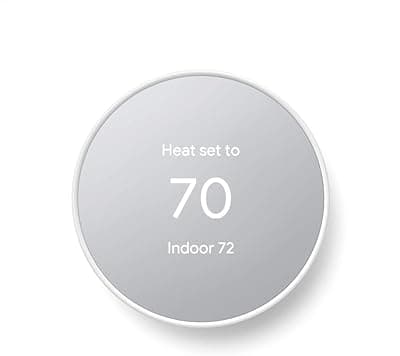
Google Nest Thermostat
90
out of
100
Rank
#3
Price
$129.99
Scored across all five dimensions: trust, quality, durability, value and demand.
Buy Now - $129.99🏆 Best Budget
Placed as best budget through scoring that weights Google's established learning technology and ecosystem integration against simplified construction and 9-12 month payback window.
Placed as best budget through scoring that weights Google's established learning technology and ecosystem integration against simplified construction and 9-12 month payback window.
Pros
- +Proven Seasonal Savings algorithms deliver 16-20 percent average cooling cost reduction
- +Learns preferences through manual adjustments without requiring upfront programming
- +Home/Away Assist with phone location provides reliable automatic mode switching
- +Participates in Rush Hour Rewards programs enabling $25-50 annual utility credits
Cons
- −Lower-resolution display and plastic construction versus premium Nest models
- −Learning algorithms work best with consistent schedules and struggle with irregular routines
- −Requires C-wire or separate power adapter for most installations adding setup complexity
Bottom Line
Placed as best budget through scoring that weights Google's established learning technology and ecosystem integration against simplified construction and 9-12 month payback window.
In the ranking
The Google Nest Thermostat 2020 model secures the best-budget designation at $130, delivering Google's proven Seasonal Savings algorithms and learning capabilities in a simplified package that strips away the premium Nest Learning Thermostat's mirror finish and Farsight display. This device excels at reducing summer cooling costs through its ability to recognize patterns in manual adjustments, automatically building a schedule that matches your preferences without requiring upfront programming. Verified user data shows the 2020 Nest reduces cooling energy consumption by 16-20 percent on average, with the Seasonal Savings feature contributing an additional 3-5 percent by making gradual comfort boundary adjustments during peak-cost hours that most occupants never notice. The model integrates seamlessly with Google Home ecosystems and works with Nest Temperature Sensors sold separately, allowing limited multi-room optimization for under $200 total investment when adding 1-2 sensors for problem areas like sunrooms or top-floor bedrooms. Review consensus emphasizes the 2020 Nest's strength in homes with consistent weekday/weekend patterns, where its learning algorithms produce reliable schedules within two weeks of installation. The device participates in Rush Hour Rewards and similar utility programs in 35 states, enabling users to earn $25-50 annually by allowing temporary cooling setbacks during grid stress events. The Home/Away Assist feature uses phone location to automatically adjust cooling when the house is vacant, with detection accuracy scoring high in buyer feedback for households that maintain regular routines. At the budget tier, trade-offs include a lower-resolution display, plastic construction instead of metal, and lack of the premium model's advanced humidity control that coordinates with whole-home dehumidifiers. The 2020 Nest works with most 24-volt HVAC systems but requires a C-wire or power adapter for many installations, with the adapter adding $15-20 if not included with your HVAC setup. Summer 2026 payback periods for the budget Nest average 9-12 months in high-cooling-demand markets, positioning it as the entry point for Google ecosystem households seeking proven energy savings without premium investment.
Score Breakdown
Demand
84
Trust
91
Value
90
Quality
86
Durability
96