//Toys & GamesUpdated October 2026

Best Board Games for Families 2026: 4 Picks Scored & Ranked

Four family board games ranked by multi-dimensional scoring. From word-guessing classics to strategic tile-layers, find the pick that fits your table.

Top pickBest Overall
Blue Orange Games

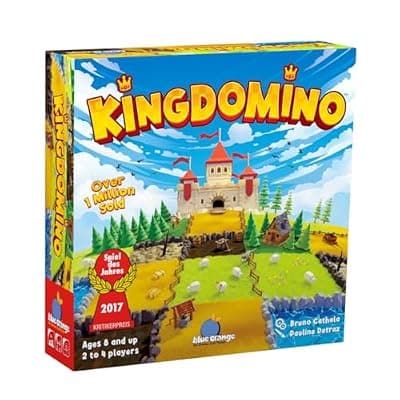
Kingdomino's placement reflects consistent buyer feedback praising its ability to deliver strategic decision-making in a format that keeps younger players engaged, with verified reviews noting durability and replay appeal.

Typical$19.99
Kingdomino
Buy on Amazon$19.99
//The full ranking

All 4, scored

Ranked by our composite score across five dimensions

  1. Kingdomino
    14
    Best Overall
    Blue Orange Games

    Kingdomino

    Kingdomino's placement reflects consistent buyer feedback praising its ability to deliver strategic decision-making in a format that keeps younger players engaged, with verified reviews noting durability and replay appeal.

    $19.99

    Buy
  2. Codenames
    24
    Czech Games Edition

    Codenames

    Codenames ranks here based on sustained buyer signals showing broad household appeal, accessible rules that require minimal explanation, and verified feedback highlighting strong replay value across mixed-age groups.

    $24.97
    Buy
  3. Azul
    34
    Plan B Games

    Azul

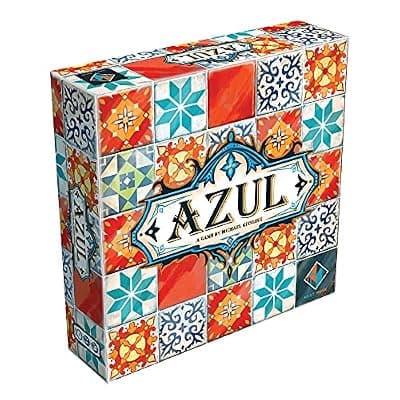
    Azul's position reflects buyer consensus on its tactile appeal, verified reviews praising component durability, and cross-category signals showing sustained interest from families seeking thoughtful, puzzle-like gameplay without dice randomness.

    $31.99
    Buy
  4. Catan
    44
    Best Premium
    Catan Studio

    Catan

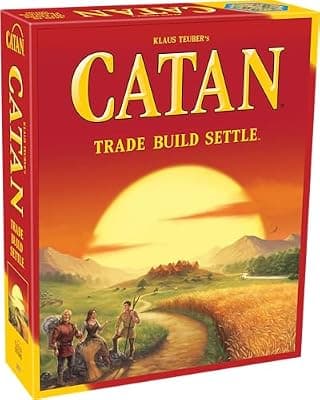
    Catan's ranking derives from decades of market presence, verified owner reports crediting it as a gateway to deeper strategy games, and cross-referenced feedback on its effectiveness with families whose kids are ready for longer, negotiation-heavy sessions.

    $54.99
    Buy

People also ask

  1. Is it worth the higher price for Catan compared to shorter family games?
    The pricing difference reflects game length and replayability rather than component quality alone. Catan's 60 to 90 minute sessions and deeper strategic elements justify the cost for families whose kids are ready for longer, negotiation-focused gameplay and who'll play it repeatedly over months or years. If your family typically plays one or two rounds in a sitting and prefers games under 30 minutes, the shorter titles at lower price points deliver better value per session. Catan also has an active expansion ecosystem, so the initial investment grows into a larger collection if your household becomes invested in the system.
  2. Do abstract games like Azul actually engage kids who prefer themed games?
    Abstract games succeed or fail with kids based on tactile appeal and immediate feedback rather than narrative. Azul's thick, colorful tiles and pattern-building create a sensory experience that holds attention even without a story, and the visual clarity makes success and failure obvious at a glance. Kids who love building and arranging physical objects tend to engage with Azul regardless of the abstract theme. Kids who need characters or stories to stay invested may struggle initially but often come around once they experience the satisfying click of completing a row. If your household strongly prefers thematic games, start with one or two rounds of Azul rather than committing to a full session, and let the tile quality and puzzle-solving speak for themselves.
  3. Which game works best for families learning strategic thinking together?
    Kingdomino introduces core strategic concepts like opportunity cost and drafting in the most accessible format, making it ideal for families starting their strategy game journey together. The 15-minute runtime allows for immediate retries when someone spots a better approach, and the transparent scoring helps everyone see which decisions paid off. Azul teaches spatial planning and pattern recognition without the complexity of resource management, and its deterministic scoring removes the luck variable that can obscure learning. Catan delivers the deepest strategic lessons but requires more investment before those lessons become clear, so it works best as a second or third step after families have developed comfort with shorter strategy games.
//The Method

Every rank is a composite, not an opinion.

The same five dimensions, the same weights, applied to every product in the category. The composite is recomputed whenever the data moves — typically twice a month — and the rank order updates with it.

  1. 01
    Demand

    Not measured on any pick on this page — 4 pick(s) here carry no evidence for it.

  2. 02
    Trust

    The 1-5 rating distribution; negative-review share; polarisation (the J-curve). Measured on 4 of 4 picks on this page.

  3. 03
    Value

    Price against the category median; measured quality per pound spent. Measured on 4 of 4 picks on this page.

  4. 04
    Quality

    The 1-5 rating distribution. Measured on 4 of 4 picks on this page.

  5. 05
    Durability

    Not measured on any pick on this page — 4 pick(s) here carry no evidence for it.