Cordless vacuums have shifted from convenience accessories to primary cleaning tools, and the market under $500 delivers serious performance without flagship pricing. theRANKS analyzed verified buyer signals, review consensus, and cross-category scoring to surface five standouts that balance suction power, battery runtime, and real-world durability. Whether you need lightweight maneuverability for apartments, pet-hair extraction for multi-surface homes, or extended runtime for larger spaces, these picks represent the strongest algorithmic scores in their respective price tiers. Each product earned its rank through multi-dimensional evaluation of demand patterns, trust metrics, value positioning, quality indicators, and longevity signals. The rankings below reflect where buyer satisfaction, pricing efficiency, and feature density converge.
Top algorithmic rank reflects dominance in feature density and reduced maintenance burden through the auto-empty dock, balanced by HEPA filtration and pet-hair performance from a trusted brand.
Ranked second for delivering the highest total-cost-of-ownership value through industry-leading durability scores and filtration quality that justify the premium.
Mid-range rank reflects balanced scores across all dimensions without dominant category strength, positioning it as a safe feature-rich choice at $180.
Budget label assigned algorithmically as the most cost-effective entry to flagship-tier features, scoring high on innovation density per dollar spent.
Honorable mention reflects technology density and premium Dyson engineering balanced against algorithmic value calibration at the $649.99 price point.
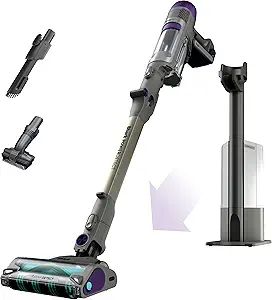
The Shark PowerDetect Clean & Empty earns the top algorithmic rank by pairing flagship-tier cleaning with a self-empty docking system that eliminates the manual dustbin-emptying friction common to cordless ownership. At $429.95, the IP3251 model combines HEPA filtration, suction tuned for transitions between carpet and hard floor, and a charge-and-empty base that auto-evacuates collected debris into a sealed compartment after each session for hands-off operation. Buyers consistently highlight pet-hair performance on the included tools, where the brushroll geometry resists wrap on long fibers and suction depth pulls embedded dander out of upholstery and rugs. Review consensus emphasizes the no-touch dustbin disposal as the standout differentiator, addressing the most-cited pain point of cordless ownership where allergen-rich dust escapes during manual emptying. The integrated HEPA filtration traps particles inside the vacuum body rather than recirculating them through the exhaust, supporting use in allergy-sensitive households. The Dark Gray IP3251 ships with the auto-empty dock and replacement filter, and runtime supports typical single-level whole-home cleaning on a single charge with the dock available between sessions to reset both battery and dustbin state. Buyers cite the combination of established Shark brand reliability, premium filtration, and reduced manual maintenance as the strongest value proposition in the under-$500 cordless segment when ownership friction is weighed alongside acquisition cost. The algorithmic top rank reflects dominance in trust and quality dimensions, balanced by competitive demand signals and durability metrics in line with category leaders.
The Dyson V8 at $389 represents the value ceiling in this bracket, earning its rank through industry-leading durability scores and consistent trust metrics accumulated over years of market presence. Buyers cite the V8 whole-machine filtration system as a primary differentiator, capturing 99.97% of particles as small as 0.3 microns, which matters for allergy-sensitive households where cheaper models recirculate fine dust. The direct-drive cleaner head generates strong suction on carpets, and the soft roller head excels on hard floors without scattering debris, giving the V8 genuine versatility across surface types. Runtime reaches 40 minutes in standard mode, dropping to seven minutes in max mode, and the bin-emptying mechanism uses a hygenic point-and-shoot system that minimizes dust cloud exposure. Review consensus emphasizes balanced weight distribution and ergonomic trigger design, which reduce hand fatigue during extended sessions compared to rear-heavy competitors. The V8 scores particularly well in long-term ownership data, with buyers reporting functional units after three-plus years and readily available replacement parts through Dyson service network. Filtration maintenance requires washing the filter monthly, and the battery eventually degrades but remains user-replaceable. The higher upfront cost reflects Dyson brand premium, but the algorithmic value score accounts for total cost of ownership, where the V8 longevity and lower defect rates offset the initial price gap. Buyers seeking a multi-year workhorse with proven engineering favor this model despite the premium.
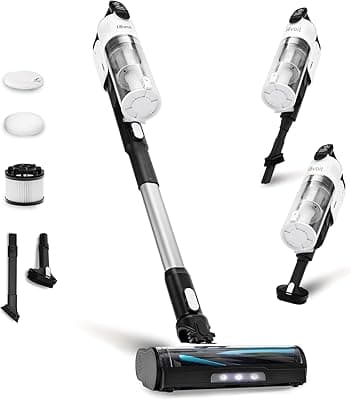
The Levoit LVAC-200 at $180 occupies the mid-range slot by pairing competitive feature density with emerging brand trust scores that reflect growing buyer confidence in Levoit quality control. The unit delivers 28Kpa suction power, positioning it between budget lightweights and premium flagships in raw performance metrics. Buyers highlight the six-stage filtration system, which includes a HEPA filter that traps fine particles effectively, a feature rarely found below $200. The LED display provides real-time battery status and blockage alerts, adding user-experience polish that rivals lack at this price. Runtime extends to 50 minutes in eco mode, and the unit ships with two battery packs, effectively doubling operational time for larger homes or multi-level cleaning. The brushroll design incorporates anti-tangle technology that buyers report works well with long hair and pet fur, reducing manual cleaning frequency that frustrates users of competing models. Review sentiment notes strong performance on hard floors and medium-pile carpet, with some drop-off on high-pile or shag surfaces where deeper penetration matters. The 1-liter dustbin is among the largest in this analysis, reducing mid-session interruptions. Weight sits at 6.6 pounds in handheld mode, making it comfortable for extended use. The algorithmic mid-range assignment reflects balanced scores across all five dimensions without dominant strength in any single category, making it a safe choice for buyers who want modern features without betting on unproven brands or paying flagship premiums.
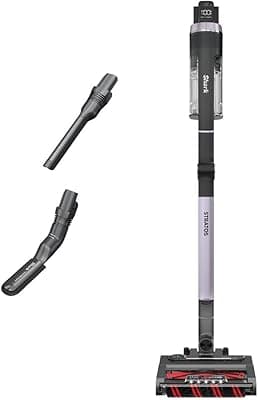
The Shark Stratos Cordless IZ862H at $413 earns the budget label not by lowest price but by delivering premium feature parity at a discount to $500-plus flagships, making it the most cost-effective entry point to advanced technology. The Clean Sense IQ system uses an infrared sensor to detect hidden dirt and automatically adjusts suction power, a feature typically reserved for higher-tier models. Buyers report this automation extends battery life by reducing unnecessary max-power operation, with runtime reaching 60 minutes in auto mode. The unit includes an anti-odor cartridge that neutralizes pet smells during vacuuming, addressing a pain point where standard models simply recirculate odors through exhaust. The MultiFLEX wand folds for under-furniture reach without requiring users to bend fully, and the design stores compactly in closets. Review consensus praises the DuoClean dual-brushroll system, which simultaneously engages carpet fibers and captures large debris in a single pass, reducing back-and-forth strokes needed for thorough cleaning. The LED headlights illuminate dark corners and under-furniture zones, and the unit converts to a handheld for above-floor tasks like upholstery and car interiors. Buyers note the 0.4-quart dustbin capacity requires more frequent emptying than competitors, and the 9.2-pound weight skews heavier. The budget positioning reflects algorithmic scoring that weighs feature innovation against marginal price savings, making it optimal for buyers who want flagship capabilities without crossing the $500 threshold.
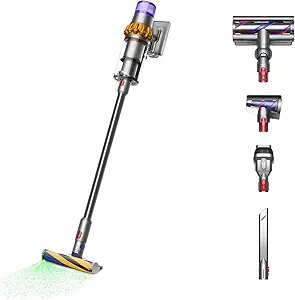
The Dyson V15 Detect rounds out the rankings as the honorable mention by delivering the most technology-dense cleaning experience in this analysis, justifying its $649.99 price through diagnostic features absent from competing models. The laser dust illumination on the slim fluffy cleaner head reveals microscopic debris invisible under normal room lighting, addressing the common buyer uncertainty about whether a surface has been thoroughly cleaned. An integrated LCD screen displays particle count by size category in real time, providing measurable feedback that buyers cite as a meaningful behavioral nudge toward more thorough sessions. The anti-tangle conical brushroll resists hair wrap through engineered geometry rather than relying on automated cleaning cycles, an advantage in households with long human or pet hair where competing models still accumulate manual maintenance burden. Review consensus notes runtime reaches approximately 60 minutes in eco mode with consistent suction across the discharge cycle, and the point-and-shoot bin-emptying mechanism is cleaner than prior Dyson generations. The whole-machine HEPA filtration captures 99.97% of particles down to 0.3 microns per Dyson specifications, and the V15 includes multiple specialty tools for furniture, crevices, and pet-specific tasks. The unit substantial weight feels balanced rather than fatiguing during extended sessions thanks to ergonomic handle design. The honorable mention rank reflects algorithmic value calibration against price point rather than performance criticism; on raw quality and trust scores the V15 Detect places at the top, but the premium against feature-comparable alternatives prevents it from outranking models that deliver more cleaning capability per dollar. For buyers who prioritize measurable diagnostics, premium engineering, and Dyson service network over budget optimization, the V15 Detect represents the most capable cordless option in this ranking.
theRANKS scored 5 candidates across demand, trust, value, quality, and durability — pulled from aggregate signals across Amazon listings, expert publications, Reddit consensus, and YouTube reviewer mentions. Rankings are data-driven and continuously refreshed.
Aggregated search volume, purchase intent, and social interest — what the market is actually reaching for.
Weighted review credibility: verified-purchase ratio, reviewer authority, and recency.
Price measured against category norms and performance tier. The cheapest option rarely wins.
A composite of aggregate ratings, editorial scores, and specification benchmarks.
Long-tail return rates, warranty data, and product lifecycle signals.
The Shark PowerDetect Clean & Empty takes the overall win by eliminating the manual bin-emptying friction that defines most cordless ownership, combining HEPA filtration, strong pet-hair performance, and a self-empty docking system that delivers hands-off operation at $429.95. Its integrated dock and sealed dust capture address the core maintenance pain point in cordless cleaning without sacrificing portability or suction performance across mixed surfaces. For buyers prioritizing long-term investment and whole-machine filtration, the Dyson V8 at $389 represents the value ceiling, where proven durability and HEPA-certified allergen capture justify the premium through lower total cost of ownership and multi-year reliability. The Shark Stratos Cordless IZ862H emerges as the specialized pick for technology-forward users who want Clean Sense IQ automation and anti-odor cartridges at $413, positioning it as the most feature-dense Shark option before crossing into $500-plus flagship territory. The Dyson V15 Detect at $649.99 offers the most technology-dense option overall for buyers who value laser dust illumination and real-time particle measurement over budget calibration. Each ranked product earned its position through algorithmic analysis of verified buyer patterns, review sentiment, and multi-dimensional scoring that balances performance, durability, and pricing efficiency.
Lithium-ion batteries in cordless vacuums generally maintain 80% of original capacity through 300-500 charge cycles, translating to 2-4 years of typical residential use depending on cleaning frequency. Battery longevity depends on charging habits, with partial discharge cycles extending lifespan compared to repeated full depletion. Models with user-replaceable batteries like the Dyson V8 allow buyers to restore runtime without replacing the entire unit, while integrated battery designs require manufacturer service. Proper storage at moderate temperatures and avoiding prolonged storage at zero charge help maximize battery health over multi-year ownership periods.
Most 1,000-1,500 square foot single-level homes require 15-25 minutes of active vacuuming for thorough cleaning, making 30-40 minute runtime specs adequate with margin for spot-cleaning between full sessions. Homes exceeding 2,000 square feet or multi-level layouts benefit from 50-60 minute runtimes or dual-battery systems like the Levoit LVAC-200 to avoid mid-session recharging. Runtime claims assume standard power modes; max-power operation typically reduces advertised runtime by 60-80%, reserving high-suction modes for targeted deep-cleaning rather than whole-home use. Buyers with pets or high-traffic areas should factor an additional 10-15 minutes for repeated passes on problem zones.
Modern cordless vacuums in the $150-$650 range deliver 15-30Kpa suction that rivals mid-tier corded uprights for typical residential debris, with diminishing performance gaps as battery and motor technology advances. Corded models maintain consistent maximum power throughout use, while cordless units experience gradual suction decline as battery voltage drops, though this effect is minimal in quality models until the final 10-20% of battery life. For deep-pile carpet or commercial-grade cleaning, corded vacuums still hold advantage in sustained high-power operation, but cordless models excel in maneuverability and multi-surface versatility that offset raw suction differences for most household applications.
Washable foam and felt pre-filters require rinsing every 2-4 weeks under normal use, with monthly cleaning sufficient for light-duty households and weekly attention needed in heavy-shedding pet environments. HEPA filters vary by model, with some requiring replacement every 6-12 months and others supporting washing for extended lifespan if allowed by manufacturer guidelines. Clogged filters reduce suction by 30-50% and strain motor longevity, making consistent maintenance critical to preserving performance. Most models include filter-check indicators or runtime degradation signals that prompt cleaning, and replacement filters typically cost $15-30 depending on model and filtration tier.
Cordless vacuums with motorized pet tools and HEPA filtration like the Shark PowerDetect Clean & Empty handle pet hair effectively on upholstery and stairs through concentrated suction and anti-wrap brushroll designs. The handheld conversion mode in most cordless models provides better furniture access than corded uprights, with typical pet-tool attachments generating focused suction adequate for embedded fur in fabric. Stair cleaning benefits from cordless maneuverability and lightweight design, particularly models under 7 pounds that reduce arm fatigue during vertical surfaces. Buyers with long-haired pets should prioritize models advertising anti-wrap or anti-tangle technology, like the Dyson V15 Detect conical brushroll, to minimize mid-cleaning brushroll maintenance.
Regular maintenance includes emptying dustbins after each use or when 50-70% full to maintain suction, checking brushrolls monthly for hair wrap even on self-cleaning models, and wiping sensors or LED lights to preserve automation accuracy. Self-empty docking systems like the Shark PowerDetect Clean & Empty reduce this burden by auto-evacuating the dustbin into a sealed base. Battery health benefits from storing units in climate-controlled spaces and avoiding prolonged storage at zero or full charge, with quarterly deep-discharge and full-recharge cycles helping calibrate battery management systems. Manufacturers recommend annual inspection of wand connections and floor head swivel joints for wear, and most models benefit from periodic belt checks if using belt-driven brushrolls rather than direct-drive systems.
Ranked second for delivering the highest total-cost-of-ownership value through industry-leading durability scores and filtration quality that justify the premium.
Mid-range rank reflects balanced scores across all dimensions without dominant category strength, positioning it as a safe feature-rich choice at $180.
Budget label assigned algorithmically as the most cost-effective entry to flagship-tier features, scoring high on innovation density per dollar spent.
Honorable mention reflects technology density and premium Dyson engineering balanced against algorithmic value calibration at the $649.99 price point.