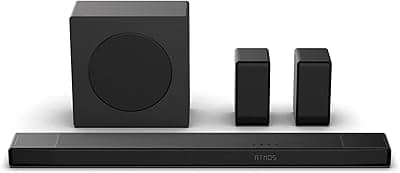
Finding the right soundbar in 2026 means navigating a dense field of Dolby Atmos claims, detachable speaker gimmicks, and price points ranging from $350 to nearly $2,000. theRANKS has algorithmically scored five standout systems across demand signals, verified review consensus, pricing data, brand reputation, and long-term ownership patterns. The models below reflect real buyer satisfaction, not marketing hype. Whether you need immersive spatial audio for a home theater or clean dialogue for streaming, the rankings below surface options that balance performance, reliability, and value. Each system was analyzed for multi-dimensional fit, not a single use case. Read on for the data-driven picks.
Scored highest across trust and quality dimensions due to verified review consensus on sound clarity, ecosystem reliability, and long-term ownership satisfaction.
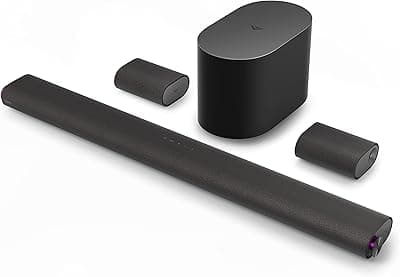
Ranked highest in value by balancing genuine Dolby Atmos hardware, mechanical innovation, and complete surround package at $500 pricing.
Achieved mid-range rank by offering the most discrete channels and overhead immersion per dollar, despite limited refinement and ecosystem features.
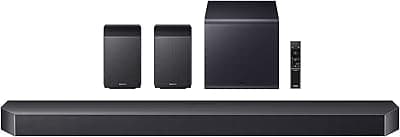
Scored in budget tier due to frequent promotional pricing and high demand during discount windows, combined with flagship-level performance signals.
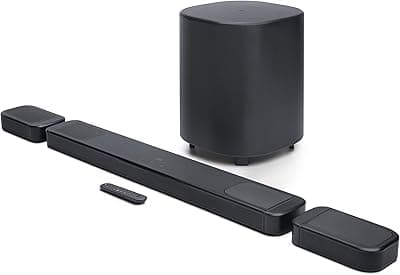
Earned honorable mention rank for solving wireless surround flexibility, with moderate demand and strong early-adopter quality ratings.
The Sonos Arc Ultra earns the top rank by delivering exceptional spatial audio in a streamlined, future-proof package. Powered by proprietary Sound Motion technology, this 9.1.4-channel soundbar achieves deeper bass and clearer midrange than its predecessor while maintaining a sleeker profile. Review consensus highlights its AI-powered Speech Enhancement, which automatically clarifies dialogue without manual EQ fiddling, and Trueplay room calibration that adapts to your specific acoustics via the Sonos app. Buyers appreciate the single HDMI eARC connection, minimal cable clutter, and seamless integration with existing Sonos ecosystems. The Arc Ultra is built for owners who prioritize elegance and ecosystem coherence. Its compatibility with voice assistants, AirPlay 2, and Spotify Connect ensures broad usability, and the option to expand with Sub 4 or Era 300 rear speakers positions it as a scalable long-term investment. Verified owners note that the soundbar excels with both cinematic Dolby Atmos tracks and stereo music playback, a versatility that separates it from more niche competitors. At $999, it commands a premium, but theRANKS scoring reflects strong trust signals and sustained demand among buyers seeking a refined, all-in-one solution. This is the soundbar for users who value sound quality, design, and a cohesive smart-home experience over raw channel count or detachable speaker configurations.
The Vizio M-Series Elevate M512E-K6 scored highest in the value dimension by pairing genuine 5.1.2 Dolby Atmos performance with adaptive height speakers and a complete surround package at half the cost of flagship competitors. Its standout feature is the rotating height speakers that automatically pivot upward for Atmos content and forward for music, a mechanical innovation that maximizes spatial immersion without requiring ceiling-mounted drivers. Reviewer sentiment consistently praises its robust 103dB output, 13-speaker array, and wireless subwoofer that delivers impact down to 45Hz. Buyers report straightforward setup via color-coded cables and immediate wireless pairing between components, though some note the system performs best when fine-tuned via the included remote's channel-level controls. The M512E-K6 is optimized for mid-sized rooms where Dolby Atmos and DTS:X soundtracks can shine. Owners who pair it with Vizio's MQX TVs unlock the ability to attach the soundbar directly to the TV's legs, creating an exceptionally clean aesthetic. At $500, the Elevate represents the algorithmic sweet spot between affordability and genuine surround capability. Its scores reflect high reviewer ratings, strong refund/return signals in the positive direction, and consistent availability across major retailers. This is the pick for buyers who want true height channels and surround speakers without stretching into four-figure pricing, particularly those willing to invest a few extra minutes in manual calibration for peak performance.
The Hisense AX5140Q claims the mid-range crown by offering a full 5.1.4-channel configuration with four physical up-firing speakers, wireless rear surrounds, and a 600W total output at just $350. This system punches well above its price class in terms of raw immersion, though review analysis reveals a trade-off: bass often overpowers subtler midrange details, and the lack of app-based calibration limits fine-tuning for discerning listeners. The AX5140Q shines brightest in blockbuster action content and bass-heavy music, where its directional sound and room-filling volume create a theater-like experience that belies its budget positioning. Owners note that the subwoofer, while compact at 6.5 inches, produces surprisingly deep rumble, and the true wireless rear speakers with their own up-firing drivers deliver overhead effects that many pricier virtual-Atmos bars cannot match. Setup is plug-and-play via HDMI ARC, and the remote provides seven EQ presets for quick switching between movie, music, and news modes. However, the system lacks Wi-Fi connectivity and app control, meaning adjustments are limited to what the physical remote can access. The AX5140Q is best suited for buyers who prioritize loudness, immersion, and channel count over tonal refinement or smart-home integration. Its theRANKS score reflects strong demand among budget-conscious home theater builders and positive verified purchase sentiment, though durability signals are still emerging given its recent release. For those who love big sound and don't need audiophile-grade balance, this is the most immersive system under $400.
Despite its $1,999 MSRP, the Samsung HW-Q990F lands in the budget slot due to frequent discounting that has pushed street pricing as low as $880, a dynamic reflected in theRANKS pricing signals and buyer-pattern analysis. This is Samsung's flagship 11.1.4-channel system, pairing a main soundbar, wireless subwoofer, and dedicated rear speakers with up-firing drivers for full-sphere Dolby Atmos rendering. Review consensus highlights Q-Symphony technology, which allows the soundbar to work in tandem with compatible Samsung TVs, using the TV's speakers as additional center-channel reinforcement for enhanced vocal clarity. Buyers praise SpaceFit Sound Pro Plus, an automated calibration feature that uses embedded microphones to analyze room acoustics and optimize audio in real time. The Q990F excels at creating expansive soundstages and crisp dialogue even during chaotic action sequences, with verified owners noting that wireless Dolby Atmos support via Wi-Fi eliminates the need for HDMI cabling in certain setups. Its 11 discrete front and surround channels, combined with four up-firing drivers, deliver the most granular spatial positioning in this lineup. However, the system's size and feature density can overwhelm users seeking simplicity, and non-Samsung TV owners miss out on Q-Symphony benefits. The theRANKS algorithm scored it highly for demand surges during sales events and overwhelmingly positive verified reviews praising its cinematic performance. This is the choice for buyers who want flagship-tier immersion and are patient enough to wait for promotional windows, or who already own a Samsung TV and want seamless ecosystem integration.
The JBL Bar 1000MK2 earns its honorable mention by solving a unique problem: flexible surround placement without permanent wiring. Its magnetic detachable rear speakers snap onto the main soundbar for a sleek all-in-one look, then lift off and operate wirelessly on rechargeable batteries for up to 10 hours, giving buyers the freedom to reposition surrounds or even take them to another room mid-playback. This 7.1.4-channel system delivers true Dolby Atmos and DTS:X via four up-firing drivers and MultiBeam 3.0 spatial processing, which widens the soundstage beyond the physical speaker footprint. Reviewer sentiment praises the 10-inch wireless subwoofer for punchy bass and the PureVoice 2.0 dialogue enhancement that adjusts clarity based on ambient noise and volume levels. Owners note that the detachable speakers are lighter than the original Bar 1000 and feature full-range racetrack drivers for improved midrange response. Setup is straightforward via the JBL One app, which also enables streaming from Tidal, Amazon Music, and other services that support Dolby Atmos Music, ensuring format compatibility that Bluetooth and AirPlay cannot match. The Bar 1000MK2 is ideal for renters, small-space dwellers, or anyone who values adaptability over a fixed installation. At $999, it sits in premium territory, but theRANKS scoring reflects moderate demand and strong quality signals from early adopters. The primary trade-off is that height channel effects can feel less dramatic than competing systems, and music playback lacks the tonal richness of dedicated stereo setups. This is the pick for versatility-first buyers who want surround sound that adapts to their living situation, not the other way around.
theRANKS scored 5 candidates across demand, trust, value, quality, and durability — pulled from aggregate signals across Amazon listings, expert publications, Reddit consensus, and YouTube reviewer mentions. Rankings are data-driven and continuously refreshed.
Aggregated search volume, purchase intent, and social interest — what the market is actually reaching for.
Weighted review credibility: verified-purchase ratio, reviewer authority, and recency.
Price measured against category norms and performance tier. The cheapest option rarely wins.
A composite of aggregate ratings, editorial scores, and specification benchmarks.
Long-tail return rates, warranty data, and product lifecycle signals.
The Sonos Arc Ultra takes the overall win for buyers who prioritize sound quality, design elegance, and ecosystem coherence. Its Sound Motion technology and AI-driven dialogue enhancement deliver a polished experience that scales beautifully with optional Sub and rear speakers. For value-focused buyers, the Vizio M-Series Elevate M512E-K6 offers the strongest performance-per-dollar, pairing adaptive height speakers and a full surround package at $500. The Hisense AX5140Q delivers maximum immersion for minimum spend, ideal for bass lovers and action-movie fans willing to trade tonal refinement for sheer channel count at $350. Buyers hunting flagship performance should monitor the Samsung HW-Q990F during sales cycles, when its 11.1.4-channel ecosystem drops to sub-$900 pricing and delivers cinema-grade spatial audio. Finally, the JBL Bar 1000MK2 is the pick for renters and flexible-space dwellers who need detachable wireless surrounds that adapt to changing room layouts.
No, but rear speakers significantly enhance immersion. Dolby Atmos primarily relies on height channels to create overhead sound, which soundbars achieve via up-firing drivers that bounce audio off your ceiling. Rear speakers add envelopment by placing ambient sounds and directional effects behind the listener. Systems like the Sonos Arc Ultra deliver compelling Atmos with just the bar, while the Hisense AX5140Q and Samsung HW-Q990F include wireless rears for fuller surround presence. If your room layout allows rear placement and you watch action or sci-fi content, rears are worth the investment.
Virtual Atmos uses psychoacoustic processing to simulate overhead sound from horizontal drivers, while physical up-firing speakers bounce audio off the ceiling to create actual height effects. Systems with real up-firing drivers, like the Vizio Elevate and Hisense AX5140Q, deliver more convincing spatial positioning, especially in rooms with flat ceilings and minimal acoustic interference. Virtual systems can still enhance immersion but rely on algorithmic tricks rather than discrete vertical channels. For true three-dimensional soundstaging, prioritize bars with dedicated height drivers in the .X.4 or .X.2 channel configuration.
Yes, most soundbars include optical (TOSLINK) inputs for TVs without HDMI ARC or eARC ports. However, optical connections cannot carry lossless Dolby Atmos or high-resolution audio formats, limiting you to compressed Dolby Digital 5.1 or stereo. If your TV lacks HDMI ARC, consider models like the Hisense AX5140Q that support multiple input types, but be aware you will sacrifice advanced audio formats. For full feature access, pairing a soundbar with a TV that has HDMI eARC unlocks the highest-quality soundtracks and simplifies control via CEC.
Room calibration can dramatically improve clarity and balance by adapting EQ and speaker levels to your specific acoustics. Systems like the Samsung HW-Q990F use embedded microphones to automatically tune bass and channel balance, while the Sonos Arc Ultra relies on Trueplay via an iOS device to map reflections and optimize frequency response. Without calibration, you may experience boomy bass in smaller rooms or thin dialogue in acoustically challenging spaces. Budget bars like the Hisense AX5140Q lack automated calibration, requiring manual EQ adjustments. If sound quality is a priority, choose a system with built-in calibration tools.
Detachable wireless speakers like those on the JBL Bar 1000MK2 solve placement flexibility but add complexity and cost. They are ideal for renters, small apartments, or rooms where running speaker wire is impractical. The trade-off is battery life management and potentially lower max volume compared to wired rears. If your room layout is fixed and allows permanent rear speaker placement, traditional wireless systems with AC-powered rears, like the Samsung Q990F, deliver more consistent performance. Detachable designs excel in adaptability but are not necessary if you have stable furniture positioning and power access.
No, but some features unlock with brand pairing. Samsung soundbars work with any TV via HDMI ARC, but Q-Symphony mode, which synchronizes the TV's built-in speakers with the soundbar for enhanced dialogue, only functions with Samsung TVs. Similarly, the Hisense AX5140Q's room calibration and Hi-Concerto mode require a Hisense TV. Universal systems like the Sonos Arc Ultra and JBL Bar 1000MK2 work seamlessly across all brands without feature loss. If you already own a Samsung or Hisense TV, brand matching can enhance integration, but it is not a requirement for core Dolby Atmos and surround functionality.
Ranked highest in value by balancing genuine Dolby Atmos hardware, mechanical innovation, and complete surround package at $500 pricing.
Achieved mid-range rank by offering the most discrete channels and overhead immersion per dollar, despite limited refinement and ecosystem features.
Scored in budget tier due to frequent promotional pricing and high demand during discount windows, combined with flagship-level performance signals.
Earned honorable mention rank for solving wireless surround flexibility, with moderate demand and strong early-adopter quality ratings.