//Coffee & EspressoUpdated October 2026

Best Coffee & Espresso: 5 Picks Scored & Ranked

Five espresso machines scored across demand, trust, value, quality and durability. From entry-level to pro-grade picks, ranked by data.

Top pickBest Overall
De'Longhi

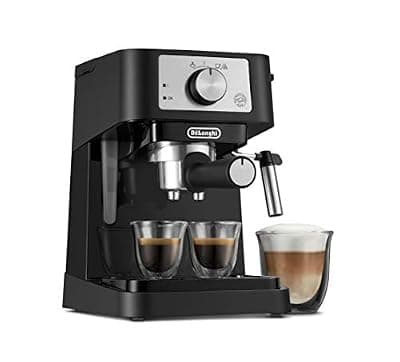
This machine's ranking reflects its role as an accessible entry model with a compact design and straightforward operation, balanced against limitations in build materials and shot control that constrain long-term use.

Typical$99.95
De'Longhi Stilosa EC260BK
Buy on Amazon$99.95
//The full ranking

All 5, scored

Ranked by our composite score across five dimensions

  1. De'Longhi Stilosa EC260BK
    15
    Best Overall
    De'Longhi

    De'Longhi Stilosa EC260BK

    This machine's ranking reflects its role as an accessible entry model with a compact design and straightforward operation, balanced against limitations in build materials and shot control that constrain long-term use.

    $99.95
    Buy
  2. Gaggia Classic Evo Pro
    25
    Gaggia

    Gaggia Classic Evo Pro

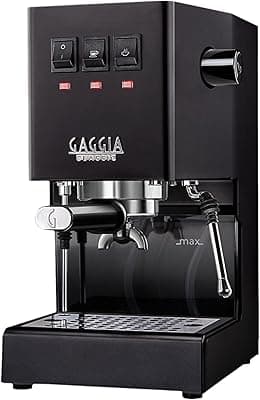
    Scored across trust, quality, durability, value, and demand.

    $505.09
    Buy
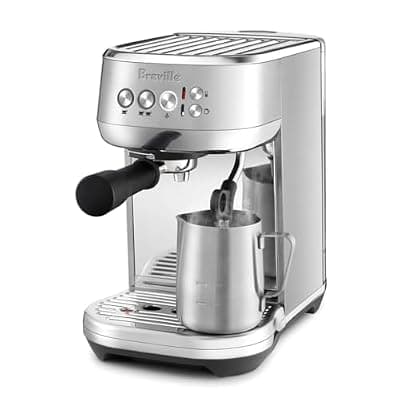
  3. Breville Bambino Plus BES500BSS
    35
    Breville

    Breville Bambino Plus BES500BSS

    The machine's ranking is driven by its fast heat-up and automated milk workflow, which suit buyers prioritizing speed and ease of use in a space-constrained setup.

    $399.95
    Buy
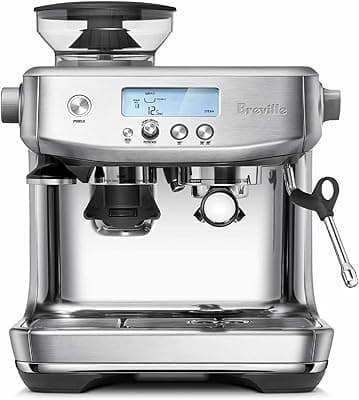
  4. Breville Barista Pro BES878BSS
    45
    Best Premium
    Breville

    Breville Barista Pro BES878BSS

    This machine's score reflects measured performance across trust, quality, durability, value, and demand, with strengths in heat-up speed and workflow efficiency balanced by trade-offs in component longevity.

    $817.04
    Buy
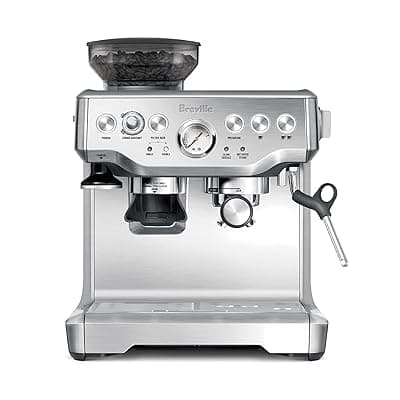
  5. Breville Barista Express BES870XL
    55
    Breville

    Breville Barista Express BES870XL

    Scored across trust, quality, durability, value, and demand.

    $499.95
    Buy

People also ask

  1. How do I choose between an integrated grinder and a standalone setup?
    Integrated grinder machines like the Barista Express and Barista Pro simplify the workflow and save counter space by combining grinding and brewing in one unit, which appeals to buyers with limited kitchen real estate or those who want a streamlined process. Standalone grinder setups paired with machines like the Gaggia Classic Evo Pro or Bambino Plus offer more flexibility to upgrade the grinder independently as your palate develops, and they often deliver better grind consistency at comparable total cost. If you plan to explore single-origin beans and dialing in nuanced profiles over time, a separate grinder gives you more headroom. If convenience and a single-device footprint matter more, an integrated model is the practical choice.
  2. Is it worth spending more for a machine with a brass boiler?
    Brass boilers retain heat more consistently than aluminum or thermoblock systems, which translates to more stable shot temperatures and better extraction consistency, particularly during back-to-back pulls. The trade-off is a longer heat-up time and often a higher upfront cost. If you plan to use the machine daily and value repairability and long-term performance, the brass boiler investment pays off. For occasional use or if fast heat-up is a priority, thermojet or thermoblock systems in machines like the Bambino Plus or Barista Pro deliver convenience without the brass boiler premium.
  3. What does a 58mm portafilter offer over a 54mm?
    A 58mm portafilter matches the commercial standard used in most cafés, which means broader compatibility with aftermarket baskets, tampers, and accessories, and it allows for slightly larger dose capacity if you prefer stronger or longer shots. Machines with 54mm portafilters like the Bambino Plus work well for most home use and keep the overall footprint compact, but the smaller basket limits dose size and reduces accessory options. If you plan to experiment with precision baskets or upgrade components over time, the 58mm size offers more flexibility. For buyers who prioritize space savings and plan to stick with included baskets, the 54mm is functionally sufficient.
  4. Do single-boiler machines actually produce café-quality espresso?
    Single-boiler machines can produce espresso that rivals café output when paired with a quality grinder, fresh beans, and proper technique, as demonstrated by the Gaggia Classic Evo Pro's high quality score and its popularity among home baristas who mod and tune their setups. The limitation is workflow, not shot quality. Single boilers require a temperature change and a brief wait when switching between brewing and steaming, which slows down drink preparation compared to dual-boiler or heat-exchanger machines. If you are making drinks one at a time and do not mind the pause, a well-built single-boiler machine delivers excellent results. For high-volume back-to-back drinks, dual-boiler systems eliminate the wait but carry a significantly higher cost.
  5. How long do home espresso machines typically last?
    Durability varies widely based on build materials and usage patterns. Machines with brass boilers and stainless steel housings, like the Gaggia Classic Evo Pro, often run for a decade or more with routine maintenance like descaling and gasket replacement. Models with more plastic components or thermoblock heating may see a shorter lifespan, particularly under daily high-volume use, though many buyers report five to seven years of reliable service. Regular descaling, using filtered water, and backflushing when applicable extend longevity across all machine types. Machines designed with user-replaceable parts and strong aftermarket support, like the Gaggia Classic line, offer better long-term value for buyers who plan to repair rather than replace.
  6. What is the real difference between pressurized and non-pressurized baskets?
    Pressurized baskets use a valve mechanism to build pressure and produce crema even with inconsistent grind or tamp, which makes them forgiving for beginners and compatible with pre-ground coffee. Non-pressurized baskets rely entirely on grind size, dose, and tamp pressure to achieve proper extraction, which gives experienced users more control over flavor but requires a quality grinder and more technique. Most machines in this ranking include both basket types, allowing you to start with pressurized and switch to non-pressurized as your skills develop. If you are new to espresso and using pre-ground coffee, pressurized baskets simplify the process. If you have a grinder and want to dial in shots, non-pressurized baskets unlock better flavor clarity.
  7. Which machine is best for a small kitchen with limited counter space?
    The Breville Bambino Plus offers the smallest footprint in this ranking while still delivering fast heat-up and automated milk frothing, making it well-suited to compact kitchens where counter space is constrained. The De'Longhi Stilosa is even more compact and fits under most cabinets, though it sacrifices some performance and build quality for the smaller size. If you need a grinder integrated to save space, the Barista Express and Barista Pro are larger but eliminate the need for a separate grinder appliance. Evaluate your total workflow footprint, including grinder and knock box, rather than just the machine dimensions, to understand what actually fits your counter.
//The Method

Every rank is a composite, not an opinion.

The same five dimensions, the same weights, applied to every product in the category. The composite is recomputed whenever the data moves — typically twice a month — and the rank order updates with it.

  1. 01
    Demand

    The retailer sales rank; review velocity over the last three months. Measured on 3 of 5 picks on this page.

  2. 02
    Trust

    The 1-5 rating distribution; negative-review share; polarisation (the J-curve). Measured on 5 of 5 picks on this page.

  3. 03
    Value

    Price against the category median; measured quality per pound spent. Measured on 5 of 5 picks on this page.

  4. 04
    Quality

    The 1-5 rating distribution; review text, including the share of it that mentions a defect. Measured on 5 of 5 picks on this page.

  5. 05
    Durability

    Reviews aged three months or more, and the share of them reporting a failure. Measured on 3 of 5 picks on this page.